Achalasia is abnormal peristalsis and failure of relaxation of the lower oesophageal sphincter.
It causes dysphagia, regurgitation, chest pain and weight loss.
Females aged 30-50 are most commonly affected.
Investigation is with oesophageal manometry and barium swallow.
The barium swallow should show a characteristic 'birds beak' appearance (image below is from wiki commons):
Treatment is with balloon dilation or hellers cardiomyotomy. Nifedipine may be temporarily helpful.
A rare and late complication of achalsia can be squamous carcinoma.
Now on to battle 21.6, which is short but sure to make you itch...
Sunday, 26 September 2010
MRCP revision battle 21.6: Scabies
Scabies is an intensely itchy condition caused by sarcoptes scabei, an arachnid which burrows into skin.
In terms of MRCP the follow facts need to be committed to memory:
Now you're itching nicely, lets attack the penultimate battle of the day, pre-eclampsia and HELLP syndrome.
In terms of MRCP the follow facts need to be committed to memory:
- first line treatment is 5% permethrin which must be applied over whole body, face and scalp and washed off after 8 to 12 hrs and repeated after 7 days
- second line treatment is 0.5% malatrion
- pruritus persists for up to 6 weeks post erradication.
- look out for pictures of lines (burrows) between web spaces of hands
Now you're itching nicely, lets attack the penultimate battle of the day, pre-eclampsia and HELLP syndrome.
Labels:
scabies
MRCP revision battle 21.7: Pre eclampsia and HELLP syndrome
Pre-eclampsia is defined as:
Possible symptoms include blurred vision, headache and abdominal pain.
Treatment is to lower blood pressure but ultimately the only way to treat pre-eclampsia which is advancing towards eclampsia (=fit) is to deliver the baby.
HELLP syndrome is a severe form of pre-eclampsia characterised by:
It complicates 10-15% of cases of pre-eclapsia.
Mortality is 20-25%
The treatment for eclampsia is IV magnesium sulphate
Now to the final battle of the day
- gestational hypertension
- proteinuria
- occurring after 20 weeks gestation
Possible symptoms include blurred vision, headache and abdominal pain.
Treatment is to lower blood pressure but ultimately the only way to treat pre-eclampsia which is advancing towards eclampsia (=fit) is to deliver the baby.
HELLP syndrome is a severe form of pre-eclampsia characterised by:
- haemolysis
- elevated liver enzymes
- low platelets
It complicates 10-15% of cases of pre-eclapsia.
Mortality is 20-25%
The treatment for eclampsia is IV magnesium sulphate
Now to the final battle of the day
Labels:
HELLP syndrome,
pre eclampsia
MRCP revision battle 21.8: Cafe au lait spots
Cafe au lait spots are light brown patches on the skin (see picture below from wiki commons):
Cafe au lait spots are associated with several conditions.
The top 4 associations I remember for MRCP are:
Which serves as a teaser for conditions I will be covering tomorrow! See you then.
Cafe au lait spots are associated with several conditions.
The top 4 associations I remember for MRCP are:
- neurofibromatosis types I and II
- tuberous sclerosis
- Fanconi anaemia
- Mc Cure-Albright syndrome
Which serves as a teaser for conditions I will be covering tomorrow! See you then.
Labels:
cafe au lait spots
Saturday, 25 September 2010
MRCP revision battle 20.1: MEN
Yet another sunny day to try and tempt me outside (who am I kidding, it worked, I've been outside had some sunshine, beer and am now back inside trying to settle)
Todays battles are going to be:
MRCP revision battle 20.1: MEN
MRCP revision battle 20.2: Folate
MRCP revision battle 20.3: Subacute combined degeneration of the spinal cord
MRCP revision battle 20.4: Vitamin B12
MRCP revision battle 20.5: Pernicious anaemia
MRCP revision battle 20.6: Churg Strauss
MRCP revision battle 20.7: ANCA
MRCP revision battle 20.1: MEN
As any of my friends will tell you MEN have frequently been a problem in my life and the condition MEN (=multiple endocrine neoplasia) has been no less troublesome. Yes, I get that they are genetic syndromes in which there are functioning hormone-producing tumours in multiple organs. My problem lies in managing to associate the different patterns to the different classes of MEN, which MRCP seems to require you to do rather a lot.
Firstly, 2 key facts to grasp:
So, to try and learn the subtypes... I've settled on learning "Para pits against the pan men, for which Phaeo gives a medal to the para" (= parathyroid, pituitary, pancreas (men gene), phaechromocytoma, medullary thyroid, parathyroid)
Which, in more conventional terms:
MEN1
MEN 2a
MEN 2b
Note that the medullary thyroid cancer in MEN is in general less aggressive than the sporadic forms but prophylactic thyroidectomy should still be considered.
As a random aside it might be worth learning that in MEN the mutation in the ret gene is activating, whereas in Hirschsprung's disease, which is also caused by a ret gene mutation, the mutation is inactivating.
So, have you got Para pits against the pan men, for which phaeo gives a medul to the para... not ideal but its the best I've come up with....
Lets move on for a brief encounter with folate....
Todays battles are going to be:
MRCP revision battle 20.1: MEN
MRCP revision battle 20.2: Folate
MRCP revision battle 20.3: Subacute combined degeneration of the spinal cord
MRCP revision battle 20.4: Vitamin B12
MRCP revision battle 20.5: Pernicious anaemia
MRCP revision battle 20.6: Churg Strauss
MRCP revision battle 20.7: ANCA
MRCP revision battle 20.1: MEN
As any of my friends will tell you MEN have frequently been a problem in my life and the condition MEN (=multiple endocrine neoplasia) has been no less troublesome. Yes, I get that they are genetic syndromes in which there are functioning hormone-producing tumours in multiple organs. My problem lies in managing to associate the different patterns to the different classes of MEN, which MRCP seems to require you to do rather a lot.
Firstly, 2 key facts to grasp:
- all MEN can be inherited or sporadic; if inherited they are autosomal dominant
- all are associated with hypercalcaemia, especially MEN 1
So, to try and learn the subtypes... I've settled on learning "Para pits against the pan men, for which Phaeo gives a medal to the para" (= parathyroid, pituitary, pancreas (men gene), phaechromocytoma, medullary thyroid, parathyroid)
Which, in more conventional terms:
MEN1
- parathyroid (95%), pituitary (70%) and pancreas (50%)
- caused by mutation of Menin gene (a tumour supressor) on chromosome 10
MEN 2a
- phaechromocytoma (95%), medullary thyroid cancer (70%) and parathyroid (60%)
- ret gene on chromosome 11
MEN 2b
- MEN 2a but without the parathyroid tumours and with a Marfarnoid appearence and mucosal neuromas
- also caused by the ret gene on chromosome 11
Note that the medullary thyroid cancer in MEN is in general less aggressive than the sporadic forms but prophylactic thyroidectomy should still be considered.
As a random aside it might be worth learning that in MEN the mutation in the ret gene is activating, whereas in Hirschsprung's disease, which is also caused by a ret gene mutation, the mutation is inactivating.
So, have you got Para pits against the pan men, for which phaeo gives a medul to the para... not ideal but its the best I've come up with....
Lets move on for a brief encounter with folate....
Labels:
MEN,
multiple endocrine neoplasia
MRCP revision battle 20.2: Folate
Have you ever been confused by the seemingly random use of either 'folate' or 'folic acid' and wondered what the difference is? Well, just in case you have, here is the answer: folate is naturally occurring vitamin B9, while folic acid is the artificial form of vitamin B9. With that cleared up, lets briefly look at folate.
Folate is important in DNA synthesis. It is also vital in the remethylation of homocysteine, which is a current area of research I'll touch on at the end.
Low folate levels result in a macrocytic anaemia. In pregnancy they also predispose to neural tube defects.
Good sources of folate include liver, green vegetables and nuts.
Drugs that decrease absorption of folate include phenytoin
Drugs that decrease its metabolism to its active form include trimethoprim, methotrexate and pyrimethamine
If a patient has low folate you should never give folic acid without B12 as doing so may precipitate, or worsen, subacute combined degeneration of the spinal cord (wait for the next battle...)
So just to round up by speaking about folate and homocysteine. Raised homocysteine levels are associated with increased risk of cardiovascular events, cerebrovascular events and fractures. Folate lowers homocysteine levels. Unfortunately, despite this seemingly simple way to decrease risk trials so far have not shown lowering levels to decrease risk.
On that wet blanket of an observation lets progress to subacute combined degeneration of the spinal cord...
Folate is important in DNA synthesis. It is also vital in the remethylation of homocysteine, which is a current area of research I'll touch on at the end.
Low folate levels result in a macrocytic anaemia. In pregnancy they also predispose to neural tube defects.
Good sources of folate include liver, green vegetables and nuts.
Drugs that decrease absorption of folate include phenytoin
Drugs that decrease its metabolism to its active form include trimethoprim, methotrexate and pyrimethamine
If a patient has low folate you should never give folic acid without B12 as doing so may precipitate, or worsen, subacute combined degeneration of the spinal cord (wait for the next battle...)
So just to round up by speaking about folate and homocysteine. Raised homocysteine levels are associated with increased risk of cardiovascular events, cerebrovascular events and fractures. Folate lowers homocysteine levels. Unfortunately, despite this seemingly simple way to decrease risk trials so far have not shown lowering levels to decrease risk.
On that wet blanket of an observation lets progress to subacute combined degeneration of the spinal cord...
Labels:
folate,
folic acid
MRCP revision battle 20.3: Subacute combined degeneration of the spinal cord
Subacute combined degeneration of the spinal cord is one of those conditions which does exactly what it says on the tin:
The loss of dorsal columns causes sensory and LMN signs, while the lateral (corticospinal) column loss cause motor and UMN signs.
Clinically the classical triad is:
Pain and temperature sensation are preserved as the spinothalamic tracts are preserved.
Subacute combined degeneration of the spinal cord is caused by B12 deficiency. Treatment is with B12, with varying levels of success.
Now it seems only sensible to have a quick recap of B12....
- subacute - it's onset is insidious
- combined degeneration - both dorsal and lateral columns affected
- of the spinal cord
The loss of dorsal columns causes sensory and LMN signs, while the lateral (corticospinal) column loss cause motor and UMN signs.
Clinically the classical triad is:
- extensor plantars (UMN)
- absent knee jerks (LMN)
- absent ankle jerks (LMN)
Pain and temperature sensation are preserved as the spinothalamic tracts are preserved.
Subacute combined degeneration of the spinal cord is caused by B12 deficiency. Treatment is with B12, with varying levels of success.
Now it seems only sensible to have a quick recap of B12....
MRCP revision battle 20.4: Vitamin B12
Vitamin B12 is essential in DNA synthesis. The body has approximately 4 yrs worth of B12 stored, 'just in case.'
B12 is found in meat and dairy, so other than vegans most people should get enough.
Absorption of B12 is specific; it requires intrinsic factor (which is released from parietal cells in the stomach) to bind to it and it is then absorbed as a complex uniquely in the terminal ileum.
Deficiency of B12 causes a variety of symptoms and signs:
Investigations will show a macrocytic anaemia, and in severe cases WCC and platelets may also be decreased.
Causes of B12 deficiency can be split into:
Treatment is to treat the cause/give B12.
Lets have a quick look at pernicious anaemia...
B12 is found in meat and dairy, so other than vegans most people should get enough.
Absorption of B12 is specific; it requires intrinsic factor (which is released from parietal cells in the stomach) to bind to it and it is then absorbed as a complex uniquely in the terminal ileum.
Deficiency of B12 causes a variety of symptoms and signs:
- anaemia
- glossitis
- dementia/depression
- peripheral neuropathy
- subacute combined degeneration of the spinal cord
Investigations will show a macrocytic anaemia, and in severe cases WCC and platelets may also be decreased.
Causes of B12 deficiency can be split into:
- insufficient intake
- vegans
- alcoholics
- anorexics
- lack of absorption
- lack of intrinsic factor
- pernicious anaemia (see next battle)
- gastrectomy
- lack of terminal ileum/absorption space
- crohns
- resection
- giardiasis
- fish tapeworm, Diphyllobothrium
- drugs interfering with absorption, eg metformin
Treatment is to treat the cause/give B12.
Lets have a quick look at pernicious anaemia...
Labels:
vitamin B12
MRCP revision battle 20.5: Pernicious anaemia
Pernicious anaemia is an autoimmune atrophic gastritis which leads to achlorhydria and lack of intrinsic factor.
It affects 1:1000 and is commonest in blood group A
Diagnosis may be by:
Treatment of pernicious anaemia is by B12 injections.
Note gastric cancer is 3x more common in people with PA.
Now for some diversification into the exciting area of small to medium vessel vasculitis...
It affects 1:1000 and is commonest in blood group A
Diagnosis may be by:
- parietal cell antibodies - present in 90% of patients with PA - but also 3-10% of people without
- intrinsic factor antibodies - less common but more specific
- the schilling test - click here if it wasn't drummed into you ad nauseum at med school!
Treatment of pernicious anaemia is by B12 injections.
Note gastric cancer is 3x more common in people with PA.
Now for some diversification into the exciting area of small to medium vessel vasculitis...
Labels:
Pernicious anaemia
MRCP revision battle 20.6: Churg Strauss
Churg Strauss is a rare vasculitic disease of unknown aetiology.
The classic triad associated with it is:
Glomerulonephritis may occur with Churg Strauss but renal failure is rare.
It is pANCA positive.
Treatment is with high-dose steroids.
Now to the final battle of the day, a bit about ANCA...
The classic triad associated with it is:
- asthma
- eosinophilia
- vasculitis of small and medium vessels
Glomerulonephritis may occur with Churg Strauss but renal failure is rare.
It is pANCA positive.
Treatment is with high-dose steroids.
Now to the final battle of the day, a bit about ANCA...
Labels:
churg strauss
MRCP revision battle 20.7: ANCA
I had never heard of ANCA until I started my MRCP revision then it seemed to pop up everywhere!
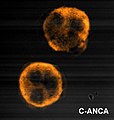
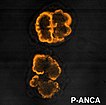
ANCA stands for anti-neutrophil cytoplasmic antibodies. They are mainly IgG. They are subdivided into 2 groups based on the patterns produced when they are stained:
1. cANCA
2. pANCA
Thats it for today, no war at present but I'll try and post one later
ANCA stands for anti-neutrophil cytoplasmic antibodies. They are mainly IgG. They are subdivided into 2 groups based on the patterns produced when they are stained:
1. cANCA
- cytoplasmic, anti PR3
- found in Wegeners (90%), mircroscopic polyangiitis (40%)
- some correlation between level and disease activity
2. pANCA
- perinuclear, anti MPO
- found in churg strauss (60%), crescentic glomerulonephritis (80%), microscopic polyangiitis (60%), Wegeners (60%)
- may also be seen in IBD, RA, SLE, sjogrens, autoimmune hepatitis
Thats it for today, no war at present but I'll try and post one later
Labels:
ANCA
Friday, 24 September 2010
MRCP revision battle 19.1: Myelofibrosis
I have more time than usual to revise this week and am actually finding it harder to sit down and get on with it... must have a quiet word with the motivational centres of my brain (which I believe are the mesolimbic areas... anyone care to correct me?) Anyway, today's battles will be:
MRCP revision battle 19.1: Myelofibrosis
MRCP revision battle 19.2: Hepatitis
MRCP revision battle 19.3: Peutz Jegher Syndrome
MRCP revision battle 19.4: Familial Adenomatous Polyposis
MRCP revision battle 19.5: Hereditary Non-Polyposis Colorectal Cancer
MRCP revision battle 19.6: LTOT
MRCP revision battle 19.7: Exercise tolerance tests
MRCP revision battle 19.8: Lead poisoning
MRCP revision battle 19.1: Myelofibrosis
Myelofibrosis has always been a secret 'sweet-spot' of mine - I think because of its 'teardrop cells' - so its a good battle to start this unmotivated day on...
Myelofibrosis is fundamentally fibrosis of the bone marrow. There is hyperplasia of megakaryocytes which produce platelet-derived growth factor, leading to:
Features of myelofibrosis include:
Investigations show:
Image below shows teardrop cells.
Treatment is ?allogenic stem cell transplant.
Prognosis is poor with a median survival of 4 to 5 yrs.
Onwards to hepatitis....
MRCP revision battle 19.1: Myelofibrosis
MRCP revision battle 19.2: Hepatitis
MRCP revision battle 19.3: Peutz Jegher Syndrome
MRCP revision battle 19.4: Familial Adenomatous Polyposis
MRCP revision battle 19.5: Hereditary Non-Polyposis Colorectal Cancer
MRCP revision battle 19.6: LTOT
MRCP revision battle 19.7: Exercise tolerance tests
MRCP revision battle 19.8: Lead poisoning
MRCP revision battle 19.1: Myelofibrosis
Myelofibrosis has always been a secret 'sweet-spot' of mine - I think because of its 'teardrop cells' - so its a good battle to start this unmotivated day on...
Myelofibrosis is fundamentally fibrosis of the bone marrow. There is hyperplasia of megakaryocytes which produce platelet-derived growth factor, leading to:
- marrow fibrosis
- haemopoesis being forced to move to the spleen and liver.
Features of myelofibrosis include:
- lethargy
- weight loss
- night sweats
- massive hepato/splenomegaly
Investigations show:
- raised WCC, low Hb
- teardrop pokilocytes
- leucoerythroblastic cells (=nucleated red cells)
- raised LDH and urate as increased cell turnover
- bone marrow may produced a 'dry tap'
Image below shows teardrop cells.
Treatment is ?allogenic stem cell transplant.
Prognosis is poor with a median survival of 4 to 5 yrs.
Onwards to hepatitis....
Labels:
Myelofibrosis
MRCP revision battle 19.2: Hepatitis
There are 5 'flavours' of viral hepatitis, labeled A to E. Important general points to learn are:
So to explore the 3 most popular MRCP 'flavours' in more depth....
Hepatitis A:
Hepatitis B:
Hepatitis C:
After that wizz through some high-yield viral hepatitis facts lets move on to Peutz Jegher Syndrome
- all are caused by RNA virus' except hepatitis B, which is a DNA virus
- B and C are spread by blood/sexual contact
- A and E are spread by the faecal-oral route
- Hepatitis D essentially is only ever found as a co-infection, never alone.
So to explore the 3 most popular MRCP 'flavours' in more depth....
Hepatitis A:
- spread faeco-orally, so look out for questions featuring backpackers returning home
- incubation period is 2-6 weeks
- presents as fever, malaise, nausea
- patient likely to be jaundiced and may have hepato/splenomegaly
- treatment is supportive
- patients generally make a full recovery
Hepatitis B:
- symptoms are similar to hep A
- incubation period is longer at 1 - 6 months
- spread is blood/bodily fluids - questions likely to hint at male business traveller or other innuendo
- important to fully grasp the various antigens and their meanings:
- HBsAg: present for 1-6 months after exposure; if present for >6 months patient is a carrier
- HBeAg: present for 1.5-3 months after exposure and is marker of high infectivity
- anti HBC IgM - signifies acute infection/carrier
- anti HBC IgG - may be acute infection, carrier or cleared infection
- anti HBS - if present with anti HBC suggests recovered from hep B and naturally immune; if present alone suggests hep B vaccination
- complications of hepatitis B include:
- 5-10% chronic hepatitis
- glomerulonephritis
- increased risk hepatocellular carcinoma
- cryoglobulinaemia
Hepatitis C:
- is spread by blood/sexual contact
- blood pre 1991 wasn't screened for hep C
- <20% get an acute hepatitis but 80% get chronic hepatitis
- breast feeding is NOT contraindicated (a common MRCP fascination for some reason)
- complications:
- 80% chronic hepatitis
- 20% cirrhosis
- increased risk hepatocellular carcinoma
- Treatment: IFN alpha and ribavirin
After that wizz through some high-yield viral hepatitis facts lets move on to Peutz Jegher Syndrome
Labels:
hepatitis A,
hepatitis b,
hepatitis C,
viral hepatitis
MRCP revision battle 19.3: Peutz Jegher Syndrome
Peutz Jegher Syndrome is a condition characterised by:
It is an autosomal dominant condition caused by a mutation of gene LKB1
Complications of PJS include:
There is no specific treatment.
So lets move on from a relatively benign cause of multiple colonic polyps to a less benign one....
- pigmented 'freckles' (macules) on lips, face, palms and soles
- hamartomatous polyps in gastrointestinal tract
It is an autosomal dominant condition caused by a mutation of gene LKB1
Complications of PJS include:
- obstruction/intususception
- GI haemorrhage
- iron deficiency
- colicky abdo pain
- malignant transformation - around 50% of sufferers will have died from a cancer by the age of 60.
There is no specific treatment.
So lets move on from a relatively benign cause of multiple colonic polyps to a less benign one....
Labels:
Peutz Jegher Syndrome
MRCP revision battle 19.4: Familial Adenomatous Polyposis
Familial adenomatous polyposis is an inherited condition in which patients develop literally thousands of polyps in the GI tract. Virtually all sufferers will get cancer, usually in their 30s or 40s.
It is caused by a mutation in the tumour supressor gene APC on chromosome 5.
The appearance of the colon is:
Treatment tends to be a colectomy before cancer develops.
As an aside, a variation of FAP called 'Gardners Syndrome' exists. This is FAP plus osteomas, epidermal cysts, fibromas and retinal pigmentation.
So after 2 conditions which are defined by polyps, lets look at one which defines itself by not having polyps - Hereditary Non-Polyposis Colorectal Cancer
It is caused by a mutation in the tumour supressor gene APC on chromosome 5.
The appearance of the colon is:
Treatment tends to be a colectomy before cancer develops.
As an aside, a variation of FAP called 'Gardners Syndrome' exists. This is FAP plus osteomas, epidermal cysts, fibromas and retinal pigmentation.
So after 2 conditions which are defined by polyps, lets look at one which defines itself by not having polyps - Hereditary Non-Polyposis Colorectal Cancer
MRCP revision battle 19.5: Hereditary Non-Polyposis Colorectal Cancer
Hereditary Non-Polyposis Colorectal Cancer is an autosomal dominant condition associated with an increased risk of colorectal cancer.
90% of patients with HNPCC develop cancers, usually in the proximal colon and often poorly differentiated/highly aggressive cancers.
There is also an increased risk of breast, ovary and endometrial cancers.
HNPCC is defined by the Amsterdam criteria:
Thats quite enough bowels for one day, lets come up for some oxygen...
90% of patients with HNPCC develop cancers, usually in the proximal colon and often poorly differentiated/highly aggressive cancers.
There is also an increased risk of breast, ovary and endometrial cancers.
HNPCC is defined by the Amsterdam criteria:
- at least 3 family members with colon cancer (one a 1st degree relative)
- at least 2 generations affected
- at least 1 diagnosed under 50 yrs of age
Thats quite enough bowels for one day, lets come up for some oxygen...
MRCP revision battle 19.6: LTOT
LTOT = long term oxygen therapy = 15 or more hours of oxygen per day.
This is the only treatment to increase survival in COPD.
NICE recommends it if:
How about now trying our exercise tolerance...
This is the only treatment to increase survival in COPD.
NICE recommends it if:
- PaO2 <7.3kPa OR
- PaO2 <8kPa if
- secondary polycythaemia
- nocturnal hypoxia (questions may note 'morning headaches;
- peripheral oedema
- pulmonary hypertension
How about now trying our exercise tolerance...
Labels:
long term oxygen therapy,
LTOT
MRCP revision battle 19.7: Exercise tolerance tests
Exercise tolerance tests are starting to go out of fashion but are still currently a mainstay of assessment of angina.
I'd recommend this BMJ article for a comprehensive discussion; what follows below are just a few salient MRCP points.
ETTs are carried out according to the Bruce protocol, which is 7 sections each 3 minutes long so a maximum of 21 minutes of exercise. A modified bruce can be used in higher risk/frailer patients.
Beta blockers must be stopped the day before an ETT
Digoxin should be stopped a week before.
The test is deemed to be positive if:
Now for the last battle of the day, lead poisoning
I'd recommend this BMJ article for a comprehensive discussion; what follows below are just a few salient MRCP points.
ETTs are carried out according to the Bruce protocol, which is 7 sections each 3 minutes long so a maximum of 21 minutes of exercise. A modified bruce can be used in higher risk/frailer patients.
Beta blockers must be stopped the day before an ETT
Digoxin should be stopped a week before.
The test is deemed to be positive if:
- anginal symptoms
- BP decreases by 15mmHg or fails to increase on exercise
- arrhythmia
- ST depression
- failure to achieve target heartrate (220-age in men, 210-age in women)
- ST elevation
Now for the last battle of the day, lead poisoning
Labels:
ETT,
exercise tolerance test
MRCP revision battle 19.8: Lead poisoning
Lead poisoning is a good topic as it has 2 nice distinctive features (blue lines on nail growth margins and basophillic stippling of red blood cells.)
A more comprehensive list of lead poisoning features is:
Blue lines on the growth margin of nails affect 20% adults with lead poisoning but are rare in children.
Investigations should show:
The image below shows basophillic stippling of red blood cells (right and left arrows)
Treatment is by chelation with either EDTA, d-penicillamine or dimercaprol.
Thats today wrapped up; questions on yesterday's battles can be found here
A more comprehensive list of lead poisoning features is:
- abdominal pain
- constipation
- peripheral neuropathy
- fatigue
Blue lines on the growth margin of nails affect 20% adults with lead poisoning but are rare in children.
Investigations should show:
- microcytic anaemia
- basophillic stippling of red blood cells
- raised aminolevulinic acid levels (a haem precursor)
The image below shows basophillic stippling of red blood cells (right and left arrows)
Treatment is by chelation with either EDTA, d-penicillamine or dimercaprol.
Thats today wrapped up; questions on yesterday's battles can be found here
Labels:
lead poisoning
MRCP questions: War 18
As with previous 'wars' after 'battles' these are just a few quick questions to see if your brain cells have retained the information provided in battles 18.1 to 18.8.
Grab a piece of paper, jot down your answers then compare them to my answers here
Question 1:
Which 4 clotting cascade factors is vitamin K a cofactor for?
Question 2:
Your patient has an INR of 7 but no evidence of bleeding. What would you do?
Question 3:
A 20 year old comes to you with a rash across their back of teardrop-shaped lesions topped with some silver scales. They note they had a sore throat a week or 2 ago. What is the rash?
Question 4:
State the classical triad of symptoms for aortic stenosis.
Question 5:
A patient tells you their cardiologist said the pressure gradient across their aortic valve was 52mmHg. What grade of severity is their stenosis?
Question 6:
Your houseofficer has diagnosed PMR and wants to know how to treat it. What would you prescribe?
Question 7:
A mum brings her 16 year old son who has learning difficulties to you, saying he has been itching his bottom a lot recently. You think he has threadworms. How would you treat them?
Question 8:
Your consultant states he is admitting someone with pseudopseudohypoparathyroidism. What blood results would you expect?
The answers are here
Grab a piece of paper, jot down your answers then compare them to my answers here
Question 1:
Which 4 clotting cascade factors is vitamin K a cofactor for?
Question 2:
Your patient has an INR of 7 but no evidence of bleeding. What would you do?
Question 3:
A 20 year old comes to you with a rash across their back of teardrop-shaped lesions topped with some silver scales. They note they had a sore throat a week or 2 ago. What is the rash?
Question 4:
State the classical triad of symptoms for aortic stenosis.
Question 5:
A patient tells you their cardiologist said the pressure gradient across their aortic valve was 52mmHg. What grade of severity is their stenosis?
Question 6:
Your houseofficer has diagnosed PMR and wants to know how to treat it. What would you prescribe?
Question 7:
A mum brings her 16 year old son who has learning difficulties to you, saying he has been itching his bottom a lot recently. You think he has threadworms. How would you treat them?
Question 8:
Your consultant states he is admitting someone with pseudopseudohypoparathyroidism. What blood results would you expect?
The answers are here
Subscribe to:
Posts (Atom)