Friday, 3 September 2010

MRCP revision battle 1.3: Addisons

The brief review of Addissons disease didn't throw up much that I wasn't already very familar with, and if you're revising for part 2 chances are you're already fairly close buddies with it too.  

However, it was worth looking at for a recap of drugs that can induce Addissons (rifampacin, phenytoin, carbamazepine) and to be reaquinted with the eponymous syndrome Waterhouse Friederchsen...

Waterhouse Friederchsen Syndrome: bilateral adrenal haemorrhage, usually secondary to meningococcal sepsis but can also be due to sepsis caused by strep, staph or h.influenzae.


Should you feel the need for a more comprehensive recap of Addisons disease please click here for wiki's take on it.


MCRP revision battle 1.2: CSF

Analysis of CSF

Questions involving CSF are common, and there are just some facts and lists that you have to 'suck it up' and learn...


Normal values 
  • normal protein 0.2-0.4 g/l
  • red cells 0
  • WCC <5/mm3
  • glucose >2/3 plasma

CSF in meningitis
  • Bacterial: cloudy appearence, high protein, low glucose, polymorphs
  • Viral: clear or cloudy appearence, normal protein, normal glucose, lymphocytes
  • TB: fibrin webs, high protein, low glucose, lymphocytes

Causes of very high protein in CSF (>2g/l)

Remember as BLOCK TB with FUNGAL GBS 
= spinal block, TB meningitis, fungal meningitis and GBS.


Causes of high protein in CSF
  
Remember as ABCDE... and an N
= abscess, bacterial meningitis, cancer, subDural, viral Encephalitis and neurosyphillis.


Causes of Low glucose in CSF

bacterial/fungal/TB meningitis, 20% mumps meningitis, 20% herpes encephalis and occasionally SAH.


Lymphocytosis in CS

Remember as HB HVLLS (a bit like the front of a ship made of pencil lead...)
= 'half bacteria' (ie partially treated bacterial meningitis), HIV, viral meningitis/encephalitis, lymphoma/leukaemia, Lyme disease, SLE.

 
Oligoclonal bands in CSF 

Remember as MS, NS NS, S S, GBS
MS, neurosarcoid, neurosyphillis, SLE, rarely SAH, GBS.


If you're still up for battle 1.3, click here!

MRCP revision battle 1.1: pituitary apoplexy

My approach to revision has always been to attempt a question, then when I fail use it as a 'spring board' to bounce off into a topic that the question has highlighted I'm less familiar with.  What I've always found in the past is that initially each question produces a whole set of 'learning needs', but as revision progresses fewer 'black holes of knowledge' or 'grey holes of partially forgotten information' are revealed.

It was therefore not entirely a surprise that the first time I sat down to revise I only got through one question as it uncovered so many things I needed to read up on!

These were:
- pituitary apoplexy (which in turn prompted revision of the anatomy of the cavernous sinus)
- analysis of CSF fluid
- brief review of Addisons disease

As you can see, there is a certain degree of randomness about the topics generated each day.  To try and make this blog easier for me (and potentially others) to use for revision in the future I've decided to split each day into a series of 'mini-battles', essentially separating the topics into different posts.  So, in the case of today this post is battle 1.1 and will just cover pituitary apoplexy, and then I'll do a post entitled battle 1.2 to cover analysis of CSF fluid and battle 1.3 to cover Addissons disease.

The other benefit to this is that if you want to avoid my waffle you can just skim down the first part of each post headed by 'battle x.1' and then all other battles will be info-dense, waffle light but hopefully still contain a sprinkling of humour!


So, with no further ado onto to the main meat of battle 1.1!


Pituitary apoplexy

Pituitary apoplexy describes a condition caused by sudden haemorrhage into or infarction of the pituitary gland, usually in a patient already known to have a pituitary adenoma.

It should be considered in questions where the patient has meningitis-like symptoms (neck stiffness, headache, vomiting) and also eye signs such as bitemporal superior quadrantanopia or opthalmoplegia.  Low BP may also be a feature.

Pituitary apoplexy is diagnosed by CT/MRI, and treatment is essentially surgical but immediate medical management would involve ABCD, balancing of electrolyte disturbances and a dose of hydrocortisone, since loss of the pituitary is going to cause levels to plummet (and hence the low BP).


I have a guilty love of eponymous syndromes and happily pituitary apoplexy has one associated with it:  Sheehans syndrome.  To highlight any eponymous syndromes snuck into posts I will be writing them in purple...

Sheehans syndrome is pituitary apoplexy after childbirth, usually (but not always) associated with postpartum haemorrhage. 


Having revised pituitary apoplexy, it makes sense to just sneak in a spot of relevant anatomy revision (partly cos I'm a geek, partly because if you understand the anatomy it makes the medicine easier):


Revision of anatomy of cavernous sinus

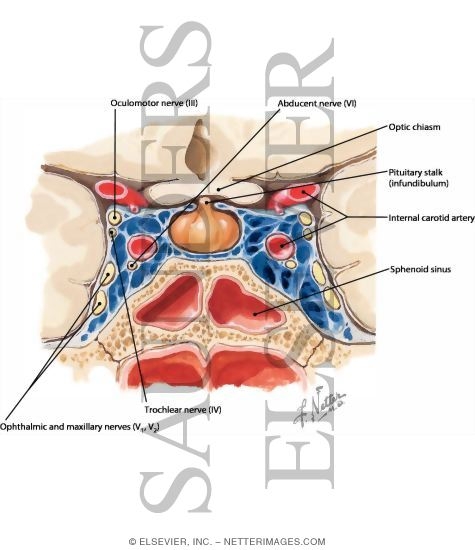
The cavernous sinus around the pituitary gland contains CN III, IV, V1, V2 and VI, also the internal carotid artery.  Note CN II runs just above it.

A nice picture can be found here from the fabulous Netter images collection.


Click here for battle 1.2!

Thursday, 2 September 2010

Preparing for Battle

So the big step of deciding to take exam has been made, meaning its time some procrastinating before actually facing what I've decided to work for entails.  Or, more positively, time for preparing.

Firstly, being a stationary addict, I had to head out to stock up on the essentials.  For me this means highlighters, black biros and Oxford project books - WHSmith sell them at around £3.50 - as they have nice thick paper so you can highlight on both sides to your hearts content.

Next, I gathered a sensible set of books to work from.  I've gone for :

1 ) Essential Revision Notes for MRCP by Kalra, which was utterly invaluable during part 1


 2) Trusty cheese and onion, AKA Oxford Handbook of Clinical Medicine, as combines the virtues of being both comprehensive and concise


3)  Kumar and Clark's Clinical Medicine, for when more depth is needed (hopefully not too often) and finally


4) My First MRCP book which I entirely failed to bond with during part 1 so I'm going to re-attempt using for part 2


So, having prepared my ammunition I joined onexamination.com to see what the battle was likely to be like...

Wednesday, 1 September 2010

Introducing MRCP and me

So, after a disportionate amount of umming and arrring and a level of indecisiveness that could literally have been fatal in my professional life I have decided to attempt MRCP part 2 written.  The exam is just over 2 months away, I am doing a ridiculously busy SHO job with a rota that leaves me perpetually jet-lagged with its rapid day-night switches and I still have a diary that includes social engagements (foolhardy I know.)  I'm therefore not entirely sure how realistic my attempt at passing will be, but I thought my brain could do with a bit of gentle exercising so I'm approaching this exam with as much gusto as one who still has some weekly rotas in excess of 60 hours can manage.

But what is this blog about?  Essentially it started out for me, to record how my learning is going and to keep my revision notes in an easily searchable and accessible format.  However, in order to encourage me to keep things concise, interesting and organised it is also being written for anyone else who is preparing for the MRCP (parts 1 or 2) and I will be trying my best to break all my posts into separate topics so eventually (hopefully) a lot of the MRCP syllabus will be covered.

I hope this blog can be a 'sweet side dish' to people's main, serious MRCP revision, something to dip into when you feel you should be working but are actually being drawn towards facebook/TV/tidying up your house/anything other than revision.  I will keep updating an index of topics that have been covered (here, or in the index link in the toolbar above), so if you choose to use this blog to help your revision you will have the options of either to following it by date, which will present you with a random set of topics hopefully almost daily, or to look at a specific topic at a time of your choosing using the index page.

I'd love to hear from anyone with suggestions for improvement/corrections/comments/jokes, and I'd also like to take this opportunity to offer the health warning that no-one except me has checked the accuracy of any of the posts and I although I apologise for any inaccuracies I accept no responsibility for their potential eventual impact on your exam/life/sanity.

Finally, as for who I am... well, a quick search of the GMC register will reveal there are no doctors called Marie Treasure, I've just opted for a degree of anonymity so I can share my failures without too much blushing!